
Graphene as a flame retardant: innovation for a more sustainable and safer industry
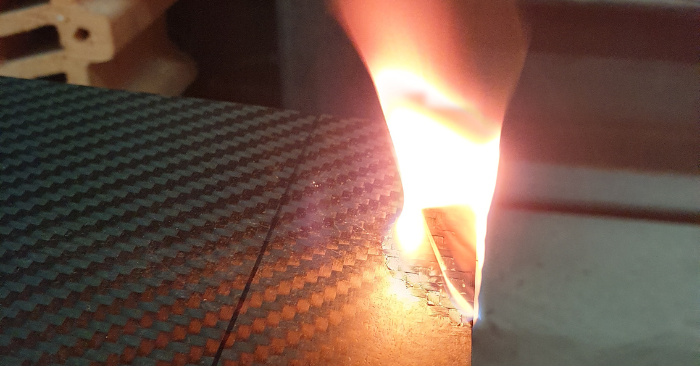
Fire safety has become one of the key challenges facing industries such as automotive, construction, and electronics. At the same time, increasing environmental and regulatory pressures are driving the development of high-performance solutions that enhance fire protection without compromising human health or the environment.
Against this backdrop, graphene as a flame retardant is emerging as a high-value technology. Thanks to its unique properties, graphene enhances the fire performance of a wide range of polymeric materials while reducing reliance on conventional flame retardants based on halogens or antimony trioxide.
One of the most innovative solutions developed by Avanzare in this field is avanFIRE GR-8, a graphene-derived flame retardant designed to deliver effective, sustainable fire protection while being free from Substances of Very High Concern (SVHCs).
Why is innovation in flame retardants needed?
Polymers, rubbers, and composite materials are found in virtually every industrial product today. However, many of these materials are highly flammable, making the use of flame-retardant additives essential to meet fire safety standards such as UL 94.
For decades, the industry has relied on halogenated flame retardants, antimony trioxide, and brominated compounds to achieve the required level of fire protection. Although these additives are highly effective, they also present significant drawbacks, including the generation of toxic smoke during combustion, environmental concerns, increasingly stringent regulatory restrictions, and challenges in recycling certain materials.
As a result, the industry is moving toward halogen-free flame-retardant formulations that offer lower toxicity and improved environmental performance while maintaining the technical properties required for demanding applications.
Graphene: much more than a nanomaterial
Graphene is widely recognized as one of the most versatile materials developed in recent decades. Consisting of a single layer of carbon atoms arranged in a hexagonal lattice, it combines exceptional mechanical, thermal, and electrical properties.
Beyond its well-known applications in electronics and energy storage, graphene is also demonstrating enormous potential as a flame-retardant additive.
Its layered structure acts as a physical barrier against heat and oxygen, slowing down the combustion process and enhancing the thermal stability of polymeric materials.
How does graphene work as a flame retardant?
Unlike many conventional flame retardants, graphene does not rely on the release of chemical substances during combustion. Instead, its flame-retardant effect is primarily based on a physical mechanism.
As the material is exposed to heat, graphene promotes the formation of a highly stable carbonaceous char layer on the polymer surface. This protective barrier reduces heat transfer, limits oxygen diffusion, decreases the release of combustible gases, and, most importantly, slows flame propagation.
Another major hazard during a fire is the dripping of molten polymers, which can spread flames to surrounding areas. Graphene-based materials help minimize this phenomenon by reinforcing the polymer matrix, thereby improving the overall fire safety of the material.
An additional advantage of graphene is that it does not necessarily replace conventional flame-retardant additives. Instead, it acts synergistically with systems based on polyphosphates, hydroxides, and phosphinates, significantly improving their performance and enabling lower overall additive loadings.
avanFIRE GR-8: graphene-based flame retardancy
To address the evolving needs of industry, Avanzare has developed avanFIRE GR-8, a flame-retardant additive formulated from a proprietary combination of graphene-derived materials.
Its main advantage lies in its ability to improve fire resistance by promoting the formation of an effective carbonaceous char layer, which reduces the fuel available to the flame while helping to dissipate the thermal energy generated during combustion.
Its key features include:
- Halogen-free formulation.
- Free from antimony oxides (SVHCs).
- Non-toxic product.
- Adjustable dosage depending on the application.
- Excellent synergy with other flame-retardant systems.
- Reduced melt dripping.
- High efficiency at low loading levels.
Compatibility with different polymer matrices
One of the key strengths of avanFIRE GR-8 is its versatility. It can be incorporated into a variety of polymer matrices while delivering excellent fire performance. These include polyurethane (PU), polyamide (PA), glass-fiber-reinforced PA6, and a range of other thermoplastics and rubber compounds through application-specific formulations. In several formulations, UL 94 V-0 classification can be achieved by combining graphene with compatible flame-retardant systems.
A solution aligned with sustainable industry
Today, sustainability is no longer just an environmental objective—it has become a key competitive advantage for manufacturers. Solutions such as avanFIRE GR-8 provide industry with an innovative alternative for developing safer, more environmentally responsible materials without compromising the performance required by today’s markets.