
Graphene in Industry: Easy and Efficient Integration

Graphene is no longer just a scientific promise; it is a reality that is transforming industry. Considered one of the most revolutionary materials of the 21st century, its unique combination of properties places it at the center of nanotechnology and the new generation of advanced materials.
What makes it so special?
It consists of an extremely thin sheet, just one atom thick, made of carbon arranged in a hexagonal structure similar to a honeycomb. Despite its nearly imperceptible lightness, graphene is extraordinarily strong, highly conductive (both thermally and electrically), and very versatile. These qualities make it an ideal candidate for applications ranging from electronics to construction, as well as sustainable mobility and green technologies.
The main challenge: integrating graphene in a uniform and safe way.
Although its properties are well known in the laboratory, implementing graphene at an industrial scale has not been straightforward. The main challenge lies in achieving a homogeneous integration of graphene within plastic materials, especially in thermoplastic matrices.
Issues such as particle aggregation, poor dispersion, or incompatibility between materials have limited its practical use. In addition, there are economic and technical barriers, as adapting traditional production lines requires significant investment, along with additional safety requirements.
In this context, the MasterGraphene project, currently being developed by Avanzare, aims to facilitate the incorporation of graphene into industrial processes without complications.
MasterGraphene: a practical solution.
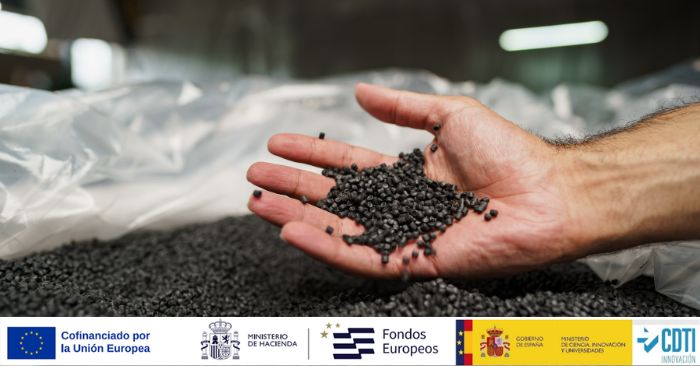
The project’s proposal is based on the development of materials in masterbatch (MB) form, with graphene concentrations that can reach up to 60%. This format acts as an industrial intermediate ready to be directly incorporated into plastic manufacturing processes, eliminating the need to modify existing infrastructure. The result is a qualitative leap toward functional polymers capable of harnessing graphene’s extraordinary properties without altering traditional production methods.
A new generation of materials.
Currently, the market already offers alternatives such as carbon nanotubes (CNTs) and certain metal-based compounds. However, these solutions often fall short when it comes to combining multiple properties into a single material.
MasterGraphene will take this a step further by enabling the simultaneous integration of structural, electrical, and thermal properties, facilitating applications that have been difficult to develop until now. In this way, the potential impact of this technology spans multiple key industries:
- Automotive: lighter, multifunctional materials that allow sensors and electronic systems to be integrated directly into parts without changing manufacturing processes.
- Electronics: the development of more resistant, lightweight casings and structural components that are compatible with smart devices.
- Aerospace: structures with high thermal resistance, excellent conductivity, and low weight, essential in demanding environments.
- Construction and sustainable mobility: more efficient, durable, and environmentally friendly solutions.
In all these cases, graphene not only enhances existing materials but also redefines what is possible with them.
A forward-looking project.
MasterGraphene was created with the ambition of transforming the advanced materials sector through applied innovation. Its pillars, such as lightness, strength, and technological integration, directly address the current needs of industry. In addition, this project is supported by funding from CDTI and ERDF (2021–2027) under the Seal of Excellence program, which highlights its strategic relevance and potential impact.
Ultimately, graphene can become a truly practical tool for industrial transformation that is easy to use, and initiatives like MasterGraphene are helping drive that change and bring a promising future for advanced materials closer to reality.