

Plastics with EMI Shielding Properties
Currently, we live surrounded by electronic devices that emit and receive electromagnetic radiation (EM). From mobile phones to medical equipment, electronic devices can generate electromagnetic interference (EMI) that affects the performance of other devices. To protect sensitive equipment and avoid this type of interference, materials with EMI shielding properties have been developed.
What is EMI Shielding?
It is a property that involves absorbing and/or reflecting electromagnetic radiation that can interfere with the operation of an electronic device. This is achieved through the use of materials that act as barriers to electromagnetic waves. This technology is essential in a wide variety of applications, such as protecting sensitive electronic circuits, reducing electromagnetic noise, and enhancing the performance of electronic devices.

Traditionally, metals such as copper, aluminum, and stainless steel alloys have been the predominant materials used for EMI shielding due to their high electrical conductivity and ability to reflect EM waves. However, they have disadvantages such as high weight, manufacturing costs, and susceptibility to corrosion.
Emergence of the use of plastics over metals with EMI shielding properties.
Plastics with EMI properties have gained prominence due to the drawbacks of metals, such as high weight, high manufacturing costs, and corrosion. However, plastics offer advantages such as lightweight, flexibility, and resistance to corrosion.
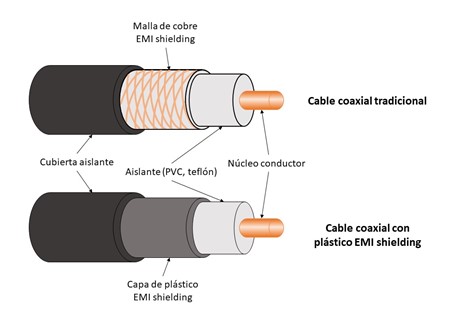
How are plastics endowed with these properties?
To convert a plastic into a material with EMI shielding properties, conductive additives are incorporated or it is coated with special substances or materials. One of the most common ways to achieve this is by adding conductive particles such as graphite, copper, nickel, or carbon fibers. These fillers create a conductive network within the plastic material, allowing it to reflect and absorb electromagnetic waves.
Another method is to apply a thin layer of metal onto the surface of the plastic using coating or spraying techniques. This provides an external metallic barrier that can deflect electromagnetic radiation.
Finally, the incorporation of carbon nanotubes, graphene, and metallic nanoparticles has shown promising results in enhancing the effectiveness of EMI shielding in plastics. These nanomaterials offer a greater contact surface area and better EM wave dispersion properties, achieving similar performance.